


If you love tactile, physical spatial puzzles that make your brain work overtime, Temple Twist is a fascinating tabletop experience. Published by Kosmos, this game challenges 1–4 explorers to navigate a shifting, vertical labyrinth, but it comes with a strict rule that might divide certain gaming groups.
What Works: Challenge and Fun
The core gameplay of Temple Twist is genuinely engaging and rewards careful planning.
-
Rewarding Difficulty: The puzzles offer a steep, satisfying challenge as you manage your limited energy (represented by your hand of action cards).
-
Tactile Gameplay: Manipulating the vertical 3D temple frame, sliding walls, rotating the structure, and watching the explorer cube tumble through the corridors is deeply satisfying.
-
High Replayability: With advanced variants like experienced mode, challenge cards, and expedition mode, the game scales up nicely to keep you coming back to crack the code.
How to Play
To give you a better idea of how it hits the table, here is how a session flows:
-
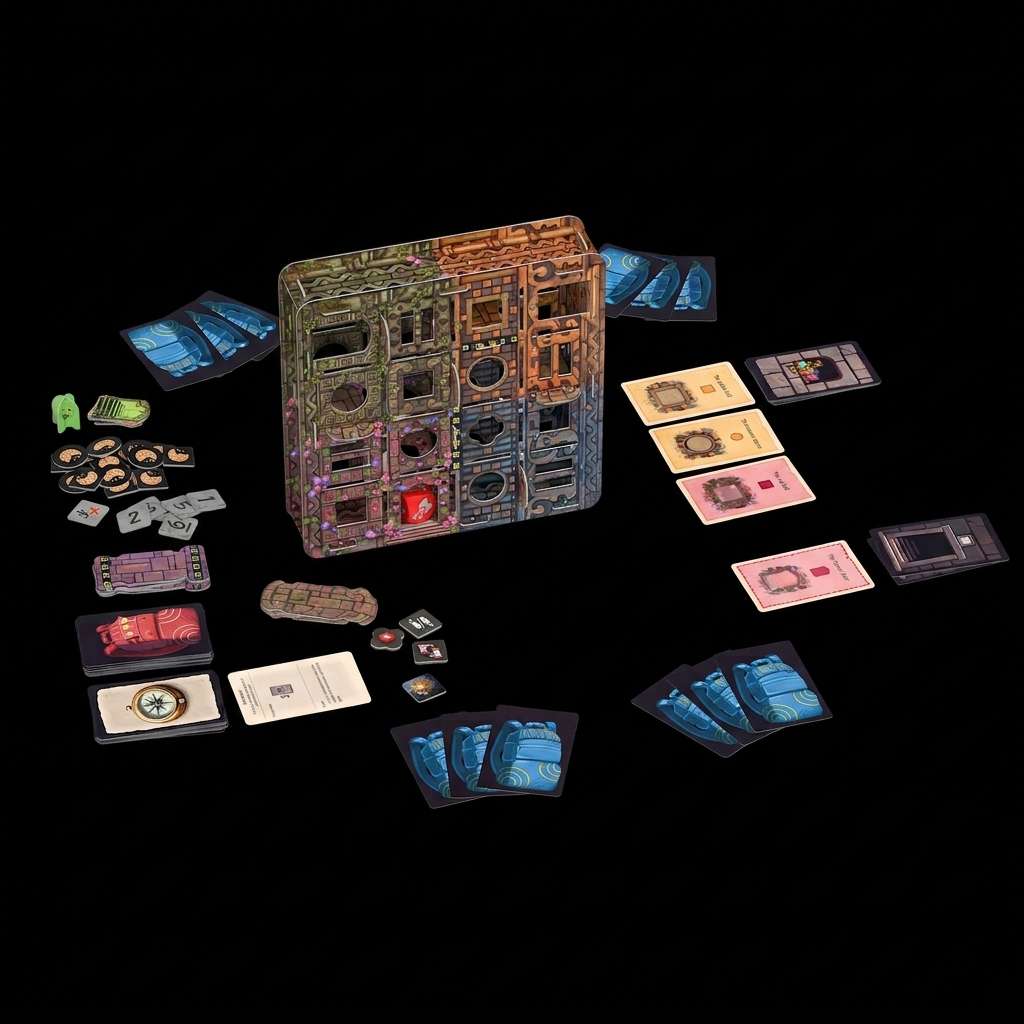
The Setup: The vertical temple frame is placed in the center of the table with the explorer cube starting inside the designated entry room. Movable walls are placed into the frame, and room and door cards are drawn to set your objectives.
-
Taking a Turn: On your turn, you must play one action card from your hand face-up onto the discard pile and take its corresponding action (or choose to ignore it). You never draw cards from a supply during a standard round, making every single card a precious, depleting resource.
-
Card Actions: Cards allow you to rotate the temple 90 degrees or freely, add/remove one or two movable walls, or move an existing wall to a new slot.
-
Checking Location: At the end of your turn, if the explorer cube rests inside one of the revealed objective rooms, that room is successfully explored and its card is flipped over.
-
Winning and Losing: To win, you must explore all the revealed rooms and guide the cube to the correct exit door when that door is positioned at the bottom of the temple. If you run out of action cards or accidentally bounce the cube completely out of the temple, the group fails the round.
The Catch: The “No Table Talk” Rule
My biggest hurdle with the game is its strict limitation on communication. While you are allowed to discuss which rooms you want to explore and when, you may not discuss your action cards. As someone who plays cooperative games for open strategy and shared table banter, silencing part of the tactical conversation feels like tying one hand behind your back. You have to execute your spatial manipulations in total isolation, which can turn a social game night into a tense, quiet room of heavy individual focus.
Final Verdict
Despite my aversion to the communication restrictions, I can’t deny that Temple Twist is challenging and undeniably fun. If you prefer co-op games where you can freely plan out loud, the silent constraints might frustrate you. However, if you want a clever, highly tactile puzzle box that burns your brain in the best way possible—either solo or with a group ready for a mental workout—it’s well worth exploring.
Discover more from DDO Players
Subscribe to get the latest posts sent to your email.