
Nightshift: A Dazzling Dive into a Unique World – A Review
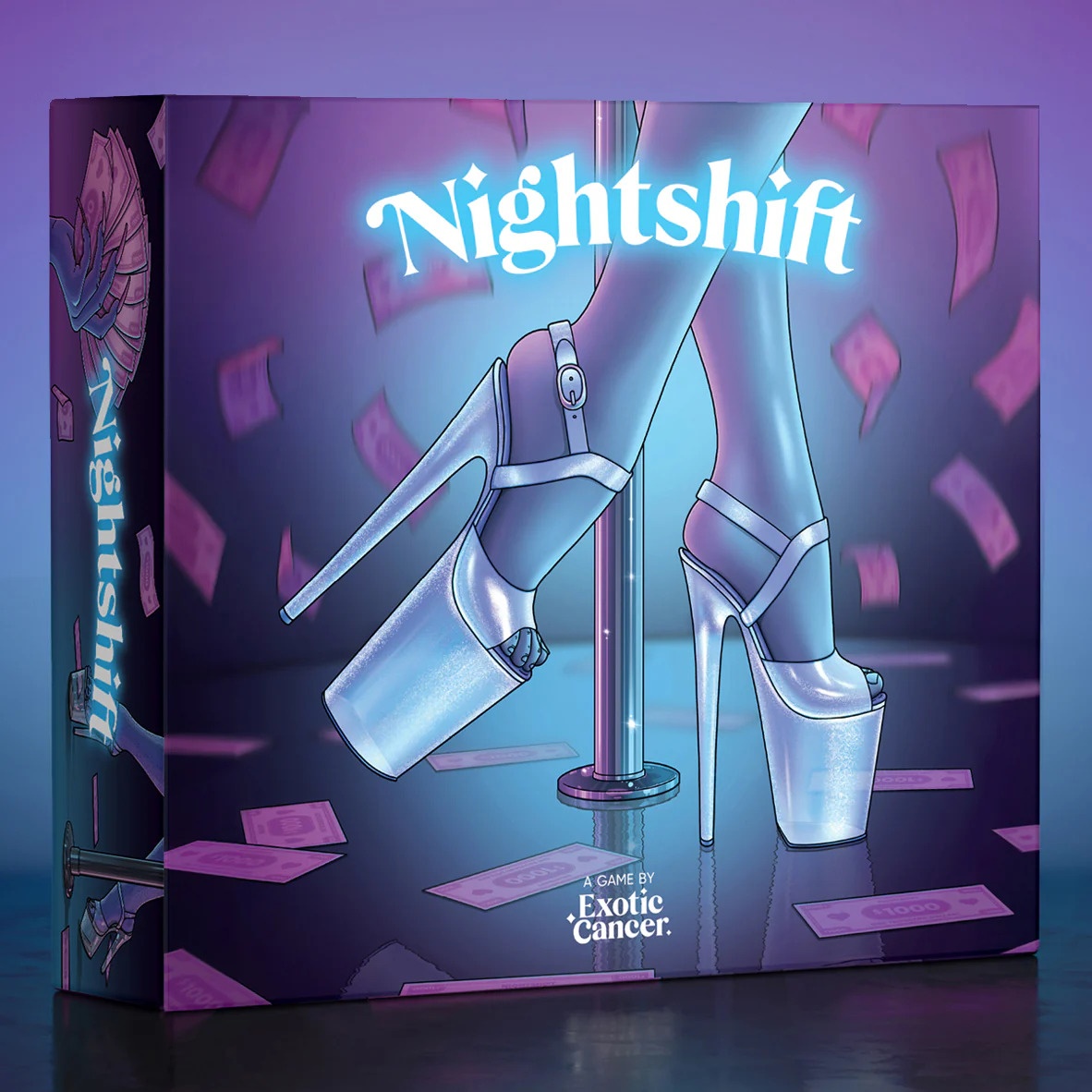
In the ever-expanding universe of board games, it’s rare to find a title that truly breaks new ground, both thematically and mechanically. Nightshift, an Australian independent board game designed and illustrated by the incredibly talented Exotic Cancer – a former stripper turned digital artist and product designer – does just that. It invites players to step into the role of one of five exotic dancers, navigating a shift, attending to customers, and striving to earn the most money before closing time. While its theme has certainly sparked conversation, when you strip away the initial buzz, Nightshift reveals itself to be a cleverly designed light-medium weight board game that stands out by drawing directly from its designer’s unique experiences to craft an unparalleled thematic journey. Theme is strong in this title, it knows what it is, and stays in that vain through the all aspects of the game.
Unboxing Brilliance: Production That Shines
What immediately captivates about Nightshift is its exceptional production quality. Every component feels meticulously chosen, balancing premium materials with a touch of thematic “bling.” Even the included paper money feels next-level, adding to the immersive experience. The custom inserts for the Drinks tokens and Cash seamlessly integrate with the large main board, creating a visually appealing and organized play area. While a four-player game might see some players reaching across, the overall layout is fantastic. My only minor suggestion for the main board would be to include a few more subtle reminders about Energy costs for certain location movements, as it’s a rule new players might occasionally overlook. The only minor quibble I have here is the card stock is not the best, I’m wondering how they will hold up overtime, I do applaud the use of the foil edges that make them sparkle in the light though.
Stepping onto the Floor: Learning and Immersion
Nightshift boasts an excellent rulebook that transforms the learning process into a breeze. Its clear structure breaks down each phase of a round, complemented by illustrative examples and walkthroughs of potential scenarios. This thoughtful design means that within just 15 minutes, you’ll feel confident enough to teach the game to almost anyone. Once laid out, the large board vividly portrays an entire strip club from a bird’s-eye view, with clearly marked zones for Customer Cards, Power Cards, and Private Room cards, enhancing the thematic immersion.
Before the shift begins, players choose one of five gemstone-themed dancers, each offering a light sprinkling of asymmetry with their own unique abilities. For instance, Ruby automatically upgrades 1-Star Customers to 2-Stars, while Emerald enjoys a permanent extra Energy point. Dancers also start with “Shot” and “Champagne” tokens – Shots offer energy boosts or dice roll modifiers on the Main Floor, while Champagne is reserved for the VIP and Private rooms to mitigate less fortunate rolls. Managing your maximum of three of each, purchasable at the Bar, adds a layer of strategic resource management. Each round of Nightshift flows through easy-to-remember phases, with excellent player aid cards serving as invaluable reminders of options and restrictions.
The Grind and the Glamour: Core Gameplay
Starting in the Dressing Room, players are allocated four Energy points to navigate the club. Moving between spaces or flipping over a Customer card costs one Energy. When interacting with a Customer, players roll a d10 to determine the outcome, ranging from negative to highly positive, especially if the Customer’s “Star” rating matches your dancer’s preferred color. Crucially, interacting with a Customer doesn’t cost Energy, allowing for rapid-fire customer reveals, but ends your turn once an interaction occurs. High rolls can lead to escorting customers to the Private or VIP Room on a subsequent turn – the primary path to significant earnings. However, a clever “stealing” mechanic allows other players to intercept a committed customer by moving to the same location and rolling equal to or higher than their Loyalty. This ruthless, yet engaging, interaction adds a layer of competitive consideration.
The Stage, centrally located, becomes a focal point during specific rounds as indicated by the Timer wheel. Dancers scheduled to perform receive two secret Power cards and a bonus of $500 per unflipped Customer card with a dollar bill icon at their table. This can lead to strategic “distraction” plays from other players to deny stage dancers their earnings. Power cards themselves can introduce a “swingy” or “take that” element, ranging from innocuous actions like redrawing cards to more impactful ones like canceling rolls or stealing energy. While some players might find these disruptive, they undeniably lean into the competitive theme of the game.
Beyond the Main Floor: VIP and Private Rooms
Players who’ve secured a spot in the Private or VIP room just before their Stage announcement face a choice: pay a $1000 fine to skip their shift or ditch their committed customer. This trade-off is clearly telegraphed by the Timer, allowing seasoned players to plan accordingly.
The Private and VIP Rooms are where dancers can truly rake in the cash. In the VIP Room, players roll a unique d10 VIP dice featuring five “Traits” (Compassion, Ego, Fun, Intellect, Fantasy), one of which each dancer inherently possesses. Rolling a new trait allows the dancer to deepen their connection with the customer, increasing their potential payout. It’s a push-your-luck gamble: roll your existing trait, and you “bust,” ending the interaction with a reduced payout. Ending rolls prematurely or rolling a new trait a second time allows you to collect cash and “subscribe” the customer for endgame scoring – a clever thematic twist that can lead to massive payouts. The Private Room, conversely, uses a deck of cards instead of a die, offering a different form of titillation. Pulling the same dance moves repeatedly can shorten the visit, creating a “Hit or Circus Flohcati”-like mini-game with a distinctly adult flavor.
Replayability, Luck, and Thematic Depth
Frequent refreshes of Customer cards and “Full Moon” events (when the “weirdos come out,” usually with positive effects) ensure the game maintains an enjoyable pace. The wide array of cards and frequent dice rolls drive the game’s engine, with multiple layers of push-your-luck mitigated by strategic use of drinks. Leaning into the theme and embracing the element of luck are key to enjoying Nightshift. While money can be played openly or hidden, the game’s inherent luck factor often makes “eagle-eyed accounting” less critical for most groups.
The inclusion of solo, co-op, and 2v2 modes significantly broadens the game’s appeal, offering alternatives for those who might prefer less direct competition. These modes, however, don’t shy away from the core thematic elements; the cutthroat competition for customers is an inherent part of the sex work industry, and Nightshift embraces this with thematic integrity. The “Online Fan” endgame scoring is a brilliant thematic twist that encourages a broader strategic outlook beyond just round-to-round tactics. The game’s theme is handled with evident care and a touch of tongue-in-cheek humor, with Customer cards that will elicit knowing winces from certain audiences. Crucially, it never feels exploitative, instead championing the idea that adult work is a legitimate profession where individuals can find enjoyment and agency.
Beyond the Controversy: A Game for the Ages?
Nightshift is undoubtedly not for everyone, and for reasons beyond its theme. While the artwork is revealing, it’s often tamer than much of the fantasy art seen in other popular games. Some will object to the theme on moral grounds, but the game’s slightly higher rules overhead might present a more significant barrier for hobby newcomers than thematic discomfort. Additionally, the longer game length might test the patience of groups less inclined towards a combination of its weight and push-your-luck elements. However, the ingenious magnetic Timer board, allowing for easy adjustment of game length, is a fantastic production touch that showcases the designer’s thoughtful approach.
In an era where tabletop gaming themes are in flux, Nightshift bravely navigates controversial waters. It directly confronts players with their comfort levels regarding the sex industry, offering a substantive game engine beneath its neon facade. Unlike many “adult” games that rely solely on shock value, Nightshift delivers solid mechanics. While it might act as a “barometer” at a local game night, potentially leading some to decline based on visuals alone, it rises far above the superficiality often associated with “adult” themes in gaming. Nightshift is a compelling example of how a mature theme can be handled with nuance and accessibility, providing a unique, often humorous, and undoubtedly conversation-starting window into a world rarely explored in the hobby. It’s a real board game about real work, and it deserves to find its way into the hands of gamers who can appreciate its bold marriage of theme and mechanics.
Disclaimer: I purchased this copy of Nightshift via the Kickstarter campaign.
Discover more from DDO Players
Subscribe to get the latest posts sent to your email.


Leave a Comment