


For more than 30 years, BioWare wasn’t just a game studio. It was one of the defining forces behind modern role-playing games, creating worlds, characters, and stories that shaped an entire generation of gamers. Now, that legacy has come to an unexpected and emotional end.
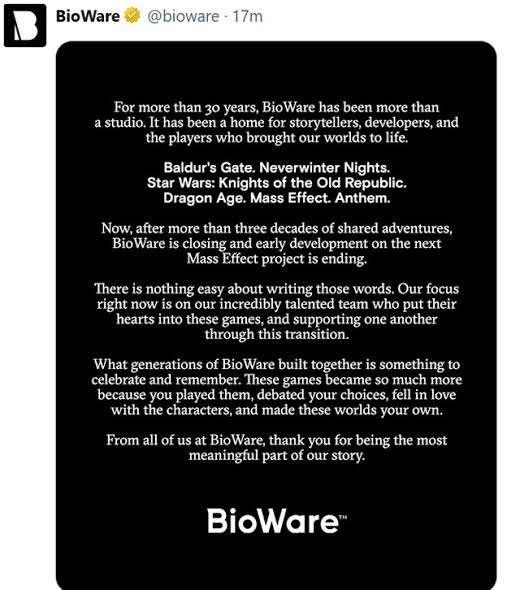
For longtime fans, this isn’t just another studio shutdown. It feels like the closing chapter of one of gaming’s most influential success stories.
The Studio That Defined Story-Driven RPGs
Founded in 1995 by Ray Muzyka, Greg Zeschuk, and Augustine Yip, BioWare quickly established itself as a powerhouse in the RPG genre. The studio built its reputation on deep storytelling, memorable companions, meaningful player choices, and expansive worlds.
Over the years, BioWare delivered some of the industry’s most beloved titles:
- Baldur’s Gate
- Neverwinter Nights
- Star Wars: Knights of the Old Republic
- Jade Empire
- Mass Effect
- Dragon Age
These weren’t just successful games. They became benchmarks for narrative design and player agency, influencing countless developers across the industry.
For many players, BioWare represented the gold standard of Western RPG development.
The Rise Under Electronic Arts
In 2007, Electronic Arts acquired BioWare, a move that initially appeared to be a perfect partnership. At the time, BioWare was preparing to launch what would become two of its biggest franchises: Mass Effect and Dragon Age.
The years that followed were arguably BioWare’s commercial peak.
The original Mass Effect trilogy became one of gaming’s most celebrated science-fiction sagas, while Dragon Age: Origins cemented itself as a modern RPG classic. BioWare had successfully transitioned from respected PC RPG developer to mainstream industry powerhouse.
However, the relationship between creative storytelling and corporate expectations would eventually become increasingly difficult to balance.
When the Cracks Began to Show
Although BioWare continued producing major releases, several projects struggled to meet expectations.
Mass Effect: Andromeda launched in 2017 to mixed reviews, drawing criticism for technical issues and failing to recapture the magic of the original trilogy.
Then came Anthem in 2019, arguably the studio’s most infamous project. Designed as a live-service multiplayer experience, the game represented a significant departure from BioWare’s traditional strengths. Despite hype surrounding its launch, Anthem failed to gain long-term traction and became a symbol of troubled development and shifting industry priorities.
Many fans viewed Anthem as the moment BioWare lost sight of what made it special.
Dragon Age: The Veilguard and the Final Blow
BioWare’s final major release, Dragon Age: The Veilguard, arrived in 2024 carrying enormous expectations. For many, it represented the studio’s chance to prove it could still deliver the type of single-player RPG experiences that built its reputation.
While the game had supporters, EA later stated that it failed to meet performance expectations. Several reports cited underwhelming player engagement and commercial performance compared to internal forecasts.
Following the game’s release, BioWare underwent additional downsizing, with many developers reassigned or laid off. The studio increasingly narrowed its focus toward the next Mass Effect title.
Unfortunately, that effort would never reach the finish line.
The Cancellation of Mass Effect
Perhaps the most heartbreaking part of the announcement is the cancellation of the next Mass Effect game.
The project was originally teased in 2020 and generated years of speculation and fan excitement. BioWare had repeatedly reassured fans that development was ongoing, and many believed the studio’s future depended on the franchise’s return.
Now, with the closure of the studio, development has officially ended.
For a franchise that became synonymous with player choice, unforgettable characters, and epic storytelling, the cancellation feels particularly painful.
Commander Shepard’s journey already had an ending. Many fans hoped the series itself didn’t.
Why Did EA Shut BioWare Down?
The answer is likely a combination of factors rather than any single failure.
BioWare spent years dealing with:
- High-profile departures of veteran talent.
- Mixed receptions to recent releases.
- The commercial failure of Anthem.
- Rising development costs.
- Industry-wide pressure to deliver consistently larger profits.
EA has stated that its restructuring is intended to focus resources on franchises with stronger long-term growth opportunities. The company has indicated continued investments in series such as Battlefield, Apex Legends, its sports portfolio, and upcoming licensed projects.
Whether fans agree with that strategy is another matter entirely.
More Than a Studio
The closure of BioWare represents more than the loss of a developer.
It marks the end of a studio that helped define what role-playing games could be.
Millions of players explored the streets of Baldur’s Gate, traveled through Thedas, fought alongside Garrus Vakarian, fell in love with companions, and made choices that felt genuinely meaningful. BioWare’s greatest achievement wasn’t simply creating games, it was creating worlds players cared about.
Few studios can claim that level of impact.
A Legacy That Won’t Disappear
Even though BioWare is gone, its influence remains everywhere.
Modern narrative RPGs continue to borrow from systems the studio helped popularize. Companion relationships, branching dialogue trees, morality systems, and player-driven storytelling have become industry standards largely because BioWare proved they could work.
The studio may no longer exist, but its DNA lives on in countless games that followed.
The final farewell from BioWare thanked players for being “the most meaningful part of our story.” It’s a fitting conclusion for a developer whose greatest achievements were always about the connections players formed with its worlds and characters.
And for many gamers, that’s exactly how BioWare will be remembered: not as a studio that closed, but as one that changed RPGs forever.
Discover more from DDO Players
Subscribe to get the latest posts sent to your email.