
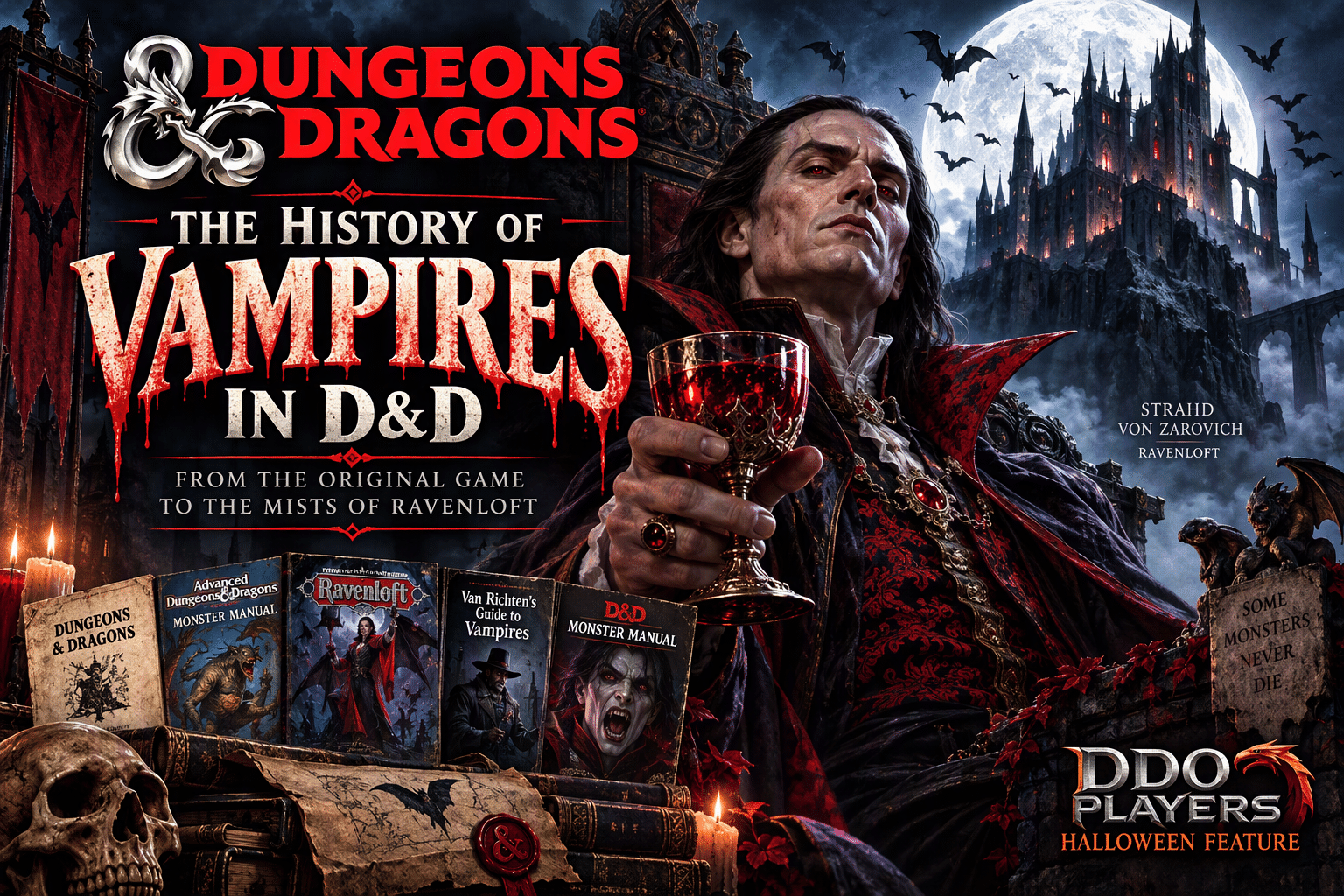
The wind rattles the shutters. Somewhere in the darkness, a wolf howls. A pale noble stands upon a castle balcony, gazing down at travelers foolish enough to wander through the mists.
For many Dungeons & Dragons players, that image is vampire horror.
Few monsters have cast a longer shadow across D&D than the vampire. Dragons may give the game its name, and liches may be the ultimate masterminds, but vampires occupy a unique place in the game’s history. They are predators, aristocrats, tragic villains, and horror icons all at once. From the earliest days of the hobby in 1974 to modern adventures like Curse of Strahd, vampires have evolved alongside D&D itself.
As Halloween approaches, it seems fitting to examine the full history of these immortal terrors and the role they have played throughout nearly every era of Dungeons & Dragons.
The Beginning: Vampires Enter D&D (1974)
Vampires have been with D&D almost from the very beginning.
The creature first appeared in the original 1974 “white box” edition of Dungeons & Dragons, making it one of the game’s earliest monsters. Vampires were presented as powerful undead beings inspired by folklore and classic horror fiction.
Interestingly, vampires had an influence on D&D that extends beyond merely being monsters.
According to D&D history, a vampire character concept appeared during Dave Arneson’s early playtest campaigns. The problems created by dealing with undead creatures eventually helped inspire the creation of one of the game’s most iconic classes: the Cleric. The cleric’s ability to turn undead became one of the earliest anti-vampire tools in the game.
Even in primitive form, vampires were terrifying opponents. Unlike skeletons or zombies, they were intelligent. They could plan. They could deceive. Most importantly, they could drain life energy from victims, one of the most feared mechanics in early D&D.
For players of the 1970s, few encounters generated more dread.
The First Edition Vampire (1977)
When Advanced Dungeons & Dragons arrived, so did a more fully realized vampire.
The 1977 Monster Manual portrayed vampires as powerful undead predators capable of life-draining attacks and shape-shifting abilities. They embodied many elements borrowed from Dracula and classic horror cinema.
The classic vampire abilities familiar to D&D fans began taking shape:
- Energy drain
- Regeneration
- Superhuman strength
- Charm and domination powers
- Transformation into animals
- Commanding wolves, bats, and rats
- Gaseous escape when defeated
Many of these abilities remain recognizable in Fifth Edition today.
Throughout the late 1970s and early 1980s, Dragon Magazine expanded vampire lore considerably. Articles introduced vampire variants from folklore around the world, including creatures inspired by Greek, Chinese, Slavic, and African traditions.
This marked an important shift.
D&D vampires were no longer just Dracula clones.
They were becoming an entire category of monsters.
A Villain Deserving His Own Story: The Birth of Strahd
No discussion of vampires in D&D can ignore the name that forever changed the game:
Strahd von Zarovich.
Before Strahd, vampires were often treated as powerful wandering monsters. You found them in a dungeon, fought them, and collected treasure.
Tracy and Laura Hickman thought that approach wasted the potential of vampires. According to accounts of the adventure’s creation, Tracy Hickman questioned why a vampire would simply be sitting in a random dungeon room among goblins and oozes. He wanted a villain with motivation, history, personality, and tragedy.
The result was revolutionary.
In 1983, TSR published I6 Ravenloft, introducing Count Strahd von Zarovich.
Strahd was:
- A conqueror
- A nobleman
- A sorcerer
- A murderer
- A vampire lord
Most importantly, he was a character.
The Hickmans drew from classic vampire literature while creating him, including Bram Stoker’s Dracula and earlier vampire traditions.
The adventure became one of the most beloved products in D&D history.
For many players, Ravenloft was the first time a campaign villain felt truly alive.
Or perhaps more accurately…
Truly undead.
Ravenloft Changes Everything
Ravenloft transformed vampires from monsters into gothic horror protagonists and antagonists.
The setting eventually expanded into an entire campaign world populated by dark powers, cursed lands, and supernatural horrors. At its heart stood Barovia and its immortal ruler, Strahd.
Unlike many fantasy villains, Strahd wasn’t seeking world conquest.
He was trapped.
Cursed.
Obsessed.
His story centered on eternal regret and an endless pursuit of lost love.
These themes became foundational to D&D’s interpretation of vampires.
Instead of simply being monsters that drank blood, vampires increasingly became:
- Tragic figures
- Fallen nobles
- Corrupted heroes
- Victims of their own ambition
This approach influenced decades of future D&D design.
The Golden Age of D&D Vampire Lore
The 1990s may have been the richest period for vampire lore.
Ravenloft expanded dramatically, and vampires became central figures in numerous sourcebooks and adventures.
One of the most influential was Van Richten’s Guide to Vampires (1991), written from the perspective of monster hunter Rudolph Van Richten.
The book examined:
- Vampire psychology
- Feeding habits
- Weaknesses
- Hunting techniques
- Vampire origins
- Regional varieties
It treated vampires almost as subjects of academic study.
For many fans, this remains among the finest monster books TSR ever produced.
The guide dramatically expanded vampire lore beyond generic folklore and introduced the idea that different strains and lineages of vampires could possess unique powers and weaknesses.
Vampire Society and Hierarchies
As D&D lore expanded, vampires became more sophisticated than solitary predators.
Sourcebooks introduced concepts including:
- Ancient vampire lords
- Vampire nobles
- Vampire spawn
- Thralls
- Secret organizations
The concept of vampire spawn became especially important.
Spawn are created by a vampire and typically remain under the creator’s influence or control. Over time this idea became one of the defining characteristics of D&D vampirism.
This created storytelling opportunities far beyond simple combat encounters.
Players could investigate disappearances, uncover conspiracies, infiltrate vampire courts, or attempt to break the control of a powerful master vampire.
Third Edition: Vampires as Templates
The arrival of Third Edition in 2000 changed many aspects of monster design.
Rather than existing solely as a standalone monster, vampirism became a template that could be applied to other creatures.
This was a brilliant innovation.
Instead of fighting only human vampires, adventurers could suddenly encounter:
- Vampire elves
- Vampire dwarves
- Vampire giants
- Vampire dragons
- Vampire spellcasters
Virtually any humanoid could become a vampire.
This dramatically increased the variety of vampire encounters and helped dungeon masters create unique undead villains.
Many unforgettable campaigns emerged from this design choice.
A vampire wizard behaves very differently from a vampire fighter.
A vampire assassin creates different horrors than a vampire king.
Third Edition leaned heavily into customization, and vampires benefited tremendously.
The Edition That Shall Be Named: The Predator Reimagined
Fourth Edition redesigned nearly every iconic monster.
Vampires became more overtly supernatural predators and received streamlined mechanics focused on combat encounters.
While some longtime fans missed older lore-heavy presentations, Fourth Edition emphasized what vampires did best during gameplay:
- Fast movement
- Brutal attacks
- Regeneration
- Charm abilities
- Tactical mobility
The edition also expanded different vampire-related enemies, including various forms of spawn and undead servants.
This era portrayed vampires as swift hunters rather than merely gothic aristocrats.
Fifth Edition and the Return of Gothic Horror
In many ways, Fifth Edition brought the history of D&D vampires full circle.
The 2016 adventure Curse of Strahd revived the classic Ravenloft storyline for a new generation.
The adventure became one of the most acclaimed Fifth Edition campaigns ever published.
Its success demonstrated something important:
Players still love vampire stories.
Strahd remains one of D&D’s greatest villains because he feels personal.
He studies the heroes.
Manipulates them.
Invites them to dinner.
Mocks them.
Tests them.
Unlike many fantasy enemies, Strahd interacts constantly with the party before a final confrontation.
That dynamic makes him unforgettable.
The Defining Traits of D&D Vampires
Across every edition, several traits have remained remarkably consistent.
The Need to Feed
Blood is still central to D&D vampirism. Vampires sustain themselves by feeding on living creatures, reinforcing their role as predators.
The Curse of Immortality
D&D repeatedly emphasizes that immortality often becomes a prison.
Many vampires achieve eternal life only to discover endless loneliness, obsession, and madness.
Shapechanging
The ability to transform into bats, wolves, mist, or other forms remains one of the creature’s signature powers.
Charm and Domination
The vampire’s greatest weapon is often manipulation rather than violence.
Their victims frequently become willing servants.
Sunlight Weakness
Though details vary by edition and setting, sunlight remains among the vampire’s most feared vulnerabilities.
The Coffin Closes
After more than fifty years of Dungeons & Dragons, vampires remain among the game’s greatest monsters.
Part of their appeal lies in versatility.
- A dragon is usually a dragon.
- A troll is usually a troll.
- But a vampire can be anything.
- A tyrant.
- A tragic lover.
- A fallen hero.
- A mastermind.
- A monster hunter’s nemesis.
- Or a lonely soul trapped by a terrible curse.
No other D&D undead combines horror, intelligence, tragedy, and raw power quite so effectively.
That is why generation after generation of players continue to fear the sound of fluttering wings outside the window.
It is why Barovia remains one of the most beloved settings in the game.
And it is why, every Halloween, somewhere around a gaming table, a Dungeon Master smiles and says:
“You notice two small puncture marks on the victim’s neck…”
And suddenly everyone pays attention.
Happy Halloween, adventurers. Watch the shadows. Count your garlic. And if a pale noble invites you to dinner in a castle overlooking the mist…
erhaps decline politely.
Discover more from DDO Players
Subscribe to get the latest posts sent to your email.