

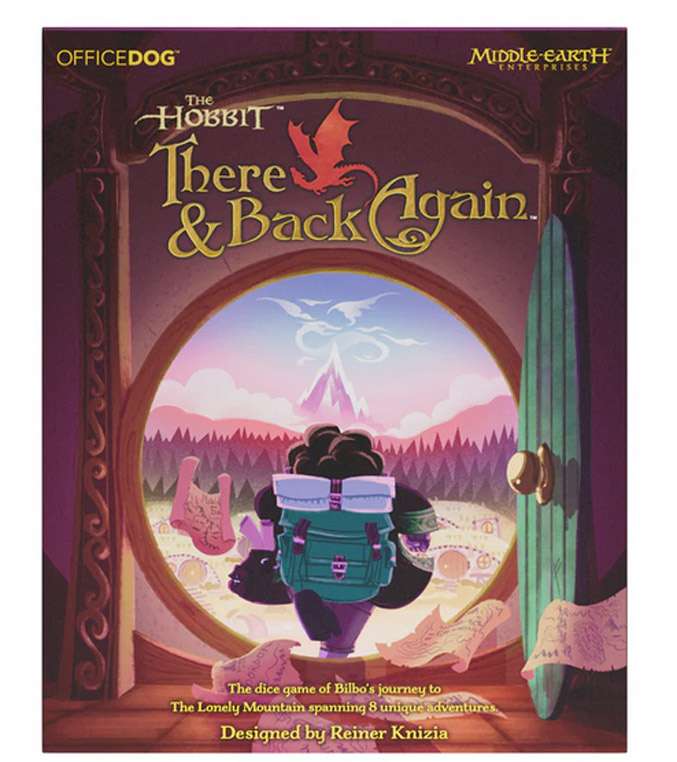
Released by Office Dog Games and designed by the legendary Reiner Knizia, The Hobbit: There and Back Again is a narrative-driven roll-and-write that manages to pack a surprising amount of tactical depth into a cozy, storybook-style package.
Unlike many games in the genre that feel like solitary math exercises, this one leans heavily into the theme of Bilbo’s journey, splitting the experience into eight distinct, replayable chapters.
The Core Mechanics
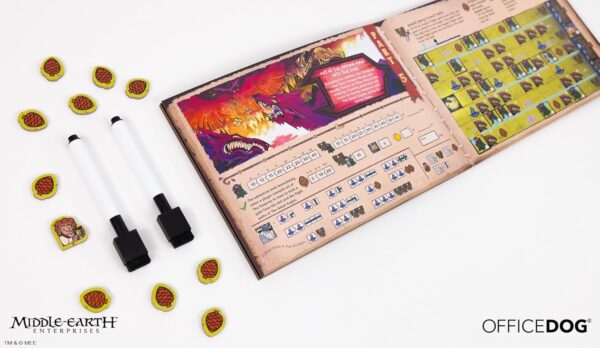
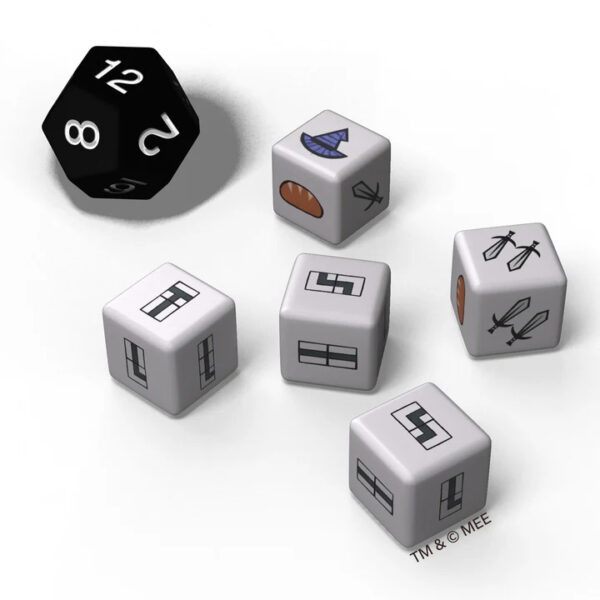
At its heart, the game uses an open dice drafting system. Each round, a pool of five six-sided dice (and occasionally a twelve-sided die) is rolled. Players take turns selecting one die at a time to perform actions on their individual dry-erase adventure books.
- Path Building: Most dice allow you to draw specific path segments. You’re trying to connect Bilbo to objectives, like dwarves to Bag End or navigating the Misty Mountains.
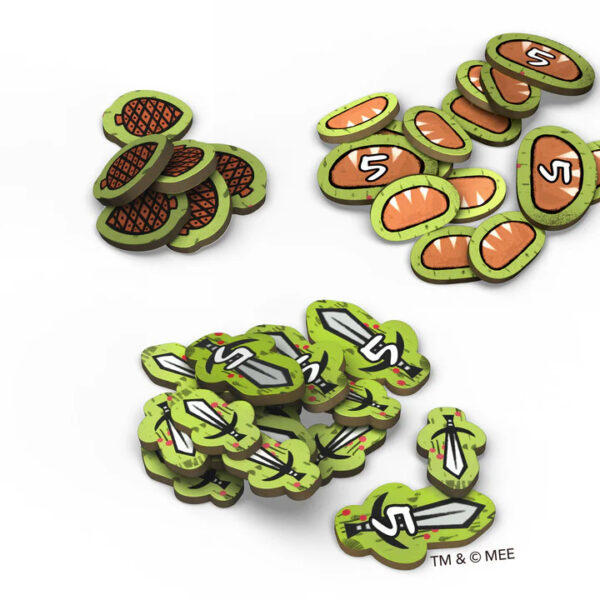
- Resource Management: Sword and Bread icons let you collect tokens or advance on tracks. These are vital for overcoming scenario-specific obstacles—you can’t just reach the destination; you often have to be prepared (like having enough bread to feed the dwarves once they arrive).
- The Wizard’s Touch: Rolling Gandalf’s hat allows you to fill in “magic” spaces, which eventually trigger powerful one-time bonuses.
Scenario-Based Progression
What makes this stand out is how each of the eight chapters introduces new rules that mirror the book’s plot.
- Chapter 1 (An Unexpected Party): Focuses on logistics—getting 12 dwarves to Bag End and ensuring they are fed.
- Later Chapters: The puzzles become more abstract and difficult, involving dodging thunderstorms, solving Gollum’s riddles, and the final confrontation with Smaug.
The components are a high point, featuring thick cardboard tokens and fabric-feel rulebooks that elevate the “cozy autumn” aesthetic.
The Verdict
The Hobbit: There and Back Again is a “thinky” puzzle disguised as a light family game. While the rules are approachable, the scoring can be surprisingly tight.
A Note on Gameplay Flow: My only significant complaint with the game is that it is very prone to “analysis paralysis.” Because the dice drafting is shared, you aren’t just looking at what helps you—you’re often looking at what your opponents need. Between calculating the best path rotation and weighing which resource is most critical for the current chapter’s goal, turns can occasionally grind to a halt as players over-optimize their sheets.
Final Thoughts:
If you can handle the occasional slow-down from a perfectionist player, this is a must-play for Tolkien fans. It’s shorter and gentler than a heavy Eurogame but offers much more strategic meat than your average “fill-in-the-box” dice game. It perfectly captures the spirit of a journey where the path you take is just as important as the destination.
Disclaimer: I purchased this copy of the game myself. This had no outcome on the review.
Discover more from DDO Players
Subscribe to get the latest posts sent to your email.